
Honeywell Technologies Wins 10 International Design Awards for Gas Detection Solutions
Red Dot and iF Design designations highlight innovation in safety technologies
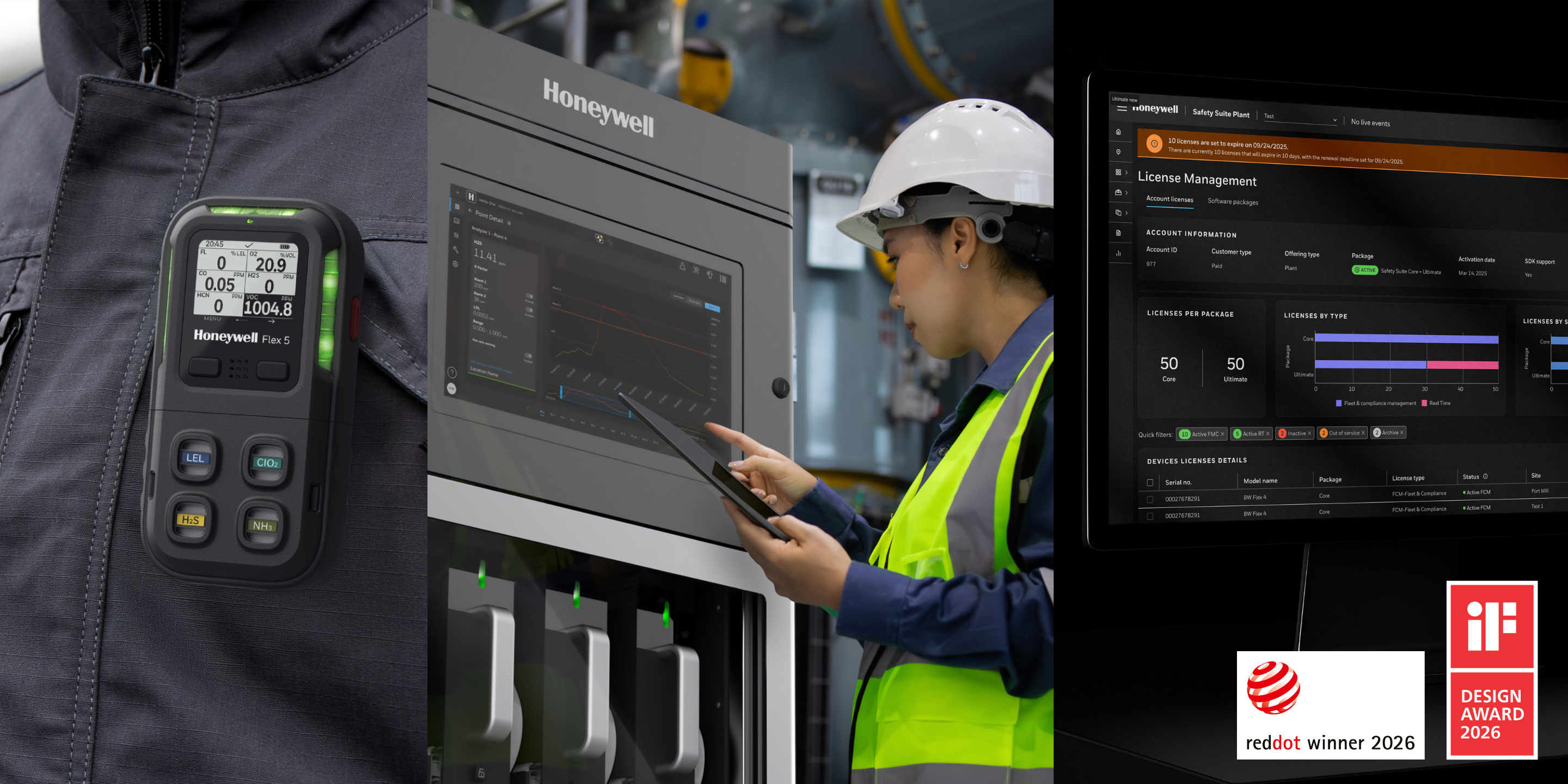
Honeywell Technologies Industrial Measurement and Control has received 10 international design awards for 2026 from Red Dot and iF Design, highlighting its commitment to developing innovative and user-friendly gas detection technologies that help increase worker safety and reduce downtime.
The iF Design Awards recognize fit-for-purpose products with exceptional form, function, sustainability and differentiation in their respective industries. A jury of 120+ design experts evaluate product submissions that rethink systems, challenge established conventions and make meaningful impacts on users. The Red Dot Awards recognize world-class design capabilities, products that push boundaries and ideas that bring industries closer to the way we may live, work and experience the world in the future.
Honeywell Technologies’ dedicated User Experience Design team is behind the success of its award-winning safety technologies. The global, multidisciplinary team is critical to ensuring products are designed with the needs of end users at the forefront. A collaboration between engineering, technology and design expertise, along with a customer focus, creates high-performing and ergonomic new products across industries.
Honeywell Technologies' 2026 Award-Winning Gas Detection Technologies
This year, the following Honeywell Technologies gas detection solutions won iF Design awards and Red Dot awards for industrial design excellence:
- Safety Suite 2.0 Software and gas detection ecosystem (iF Design awards)—Honeywell Technologies’ next-generation software for enterprise worker and asset safety is a platform integrating smart gas detection hardware with cloud-based software. Safety Suite 2.0 enables seamless device onboarding, exposure monitoring, compliance oversight and fleet management of Honeywell Technologies’ portable gas detectors. Through automated alerts and visual dashboards, it helps reduce labor efforts around safety management and increase compliance visibility.
- Vertex One Multipoint Gas Monitoring System (iF Design and Red Dot awards)—The Honeywell Technologies Vertex One continuously monitors gas distribution systems within facilities, such as semiconductor fabs and research labs, allowing organizations to promptly detect leaks that may reach toxic levels and pose risks to personnel, assets and the surrounding environment.
- Midas S2™ Gas Detector (iF Design award)—Deployed in industries like semiconductor fabs and research facilities, the Honeywell Technologies Midas S2 uses advanced sensors and patented technology to detect a broad range of toxic, ambient and flammable gases, helping to safeguard workers and operations. Its compact size fits small spaces and the modular design enables easy installation and one-click sensor or pump replacement, helping to limit potential errors and reduce downtime.
- Flex 5 Portable Gas Detector (iF Design and Red Dot awards)—The Honeywell Technologies Flex 5 is lightweight, portable multi-gas monitor that helps protect workers from gas hazards across a wide range of work environments. The modular, user-configurable design enables thousands of configurations for fast, high-quality deployment. It helps keep industrial teams and first responders connected in real time for situational awareness in mission-critical environments.
- ModRAE Gas Detector and human-machine interface (iF Design and Red Dot awards)—This Honeywell Technologies portable and modular solution detects up to seven toxic and hazardous gases at once. It can be used for personal air monitoring or for remote or confined space sampling. It can even be mounted on a drone for remote hazard monitoring. The ModRAE interface has a large LCD screen to enhance readability of the gas detectors’ outputs, vivid color alarms and guided workflows to simplify the device’s setup process.
A Design for Precise Monitoring and Easy Maintenance: Vertex One
An example of the Honeywell Technologies User Experience Design team in action is the development of the Vertex One gas monitoring system for semiconductor fabrication plants and research facilities. The system uses modular analyzers with optical blocks to detect gas levels by recording a color change on a chemically treated tape (chemcassette). Tubes connecting into the system through inlet ports take air samples from various locations throughout a site, such as the sub-fab or production floor. Vertex One can detect low levels of toxic or flammable gas with a high degree of precision, enabling operators to take action quickly if an issue arises.
“Before designing Vertex One, we researched the interaction fab workers and field service engineers have with the existing toxic monitoring systems to analyze the ergonomic friction points,” explains Mariana Gutierrez, Principal User Experience Researcher at Honeywell Technologies. “We discovered that the height of the system was an important consideration for end-users along with ease of maintenance. Customers want to increase the number of sampling points within their facilities without making the device’s footprint any larger.”
As a result, Vertex One can now take measurements from 96 gas sampling points, up from 72 in prior versions of the technology.
Maintenance considerations were equally important. Field Engineers and technicians servicing the system, whether seasoned or new to the job, should be able to understand the alerts easily without relying heavily on the device manual.
“We made the touchscreen larger on the Vertex One, expanding it to 22-inches and placing it at eye level, so any user can easily see and understand what areas of the system need to be maintained,” adds Gutierrez. “The user interface, with color-coded alerts, gives more clear guidance on diagnosing any problems.”
Vertex One now also includes three separate doors for servicing analyzers and pumps rather than a single door. By allowing technicians to only open the door closest to the area needing maintenance, the technology helps to minimize unnecessary exposure of sensitive components, reduce contamination risk and increase safety for personnel.
To learn more about Honeywell Technologies’ design team and innovative safety solutions, visit our website.