
Honeywell Technologies Honeywell Technologies
  • Who We Are
    • About Honeywell Join Honeywell on the Journey to Autonomy
    • Leadership Our senior leadership team
    • Partners Our partners in delivering value and transformation.
    Newsroom
    Explore our latest news
    Honeywell Expands Fire Portfolio with Advanced Smoke Control and Connected Life Safety Innovations
    Honeywell and MIT Find Digital Technologies can Help Increase Energy Supply, Reduce Energy Production Cost by Tens of Billions Annually
    Honeywell Technologies Hosts 2026 Investor Day; Provides New Three-Year Financial Framework
  • What We Do
    • Buildings Creating the next era of building automation
    • Industrial Driving the autonomous plant forward
    • Process Creating new energy opportunities
    Insights Hub
    Explore our latest insights
    Earn The Employee Commute Back to the Office
    CLSS is a Game-changer for Fire System Testing
    Honeywell Predicts The Top Three Building Trends of 2024
  • Honeywell Forge
  • Accelerator OS
  • Investors
  • People
    • Careers Help us build a better future
    • Life at Honeywell Discover our employee values
    • Your Career Journey When you grow, we grow
    • In the Community How we support our communities
    • Inclusion & Engagement Global perspectives for a diverse workforce
    • Integrity & Compliance Creating a culture of trust and transparency
    • Job Opportunities Find a new career with Honeywell
    • Meet Our People Get to know our truly amazing talent

    Job Opportunities

    Help shape the future of Honeywell Technologies
    Find a Career
    Professional portrait of an individual seated at a desk with a laptop against a clean background with subtle color gradient in corner.
  • Newsroom
  • Solutions
    Industries
    • Buildings
    • Chemicals + Materials
    • Data Centers
    • Healthcare
    • Heavy Industries
    • Hospitality
    • Life Sciences
    • LNG
    • Manufacturing
    • Oil + Gas
    • Low Carbon Energy
    • Utilities
    Outcomes
    • Asset Management
    • Energy Innovation
    • Operational Efficiency
    • OT Cybersecurity
    • Life Safety & Security
    • Workforce Excellence
    Businesses
    • Building Automation
    • Industrial Automation
    • Process Automation & Technology
    View All Solutions →

    Honeywell Forge

    AI-Powered, enterprise-level outcomes.
    Explore Honeywell Forge
    Vertical abstract red background with gradient tones and glowing accents, suitable for corporate visuals, digital assets, and design layouts.
    • Americas

        • Brazil - Portuguese
        • Canada - English
        • Canada - French
        • Mexico - Spanish
        • United States - English
    • APAC

        • Australia - English
        • Japan - Japanese
        • Malaysia - English
        • Republic of Korea - Korean
        • Singapore - English
    • Europe

        • Czech Republic - Czech
        • Czech Republic - English
        • Denmark - English
        • France - French
        • Germany - German
        • Italy - Italian
        • Netherlands - Dutch
        • Netherlands - English
        • Poland - Polish
        • Romania - Romanian
        • Romania - English
        • Spain - English
        • Spain - Spanish
        • United Kingdom - English
    • META

        • Saudi Arabia - Arabic
        • Saudi Arabia - English
        • Turkey - English
        • Turkey - Turkish
        • United Arab Emirates - Arabic
        • United Arab Emirates - English
    • India

        • India - English
    • China

        • China - Chinese
  • Contact
  • Support

You are browsing the product catalog for

You are viewing the overview and resources for

Sign in

to view parts associated with your account

  • Home
  • Insights
  • VESDA vs. Spot Detectors: Choosing the Right Solution for Your Data Center

VESDA vs. Spot Detectors: Choosing the Right Solution for Your Data Center

Published on 07-01-2022 Published on 07-01-2022 5 min read

Data center fires can be more than momentarily disruptive: just one fire can cost millions of dollars in lost revenue, affect thousands of businesses and put the health and safety of workers in serious jeopardy. In fact, fires and other catastrophic events reveal how indispensable data centers have become to our technology-driven global economy and why it’s vital to keep them up and running.

The consequences of smoke and fire

Unfortunately, data center failures are not uncommon. While the most frequent culprits – including hardware and software issues, power interruptions, mechanical failures, cybercrime attacks and human error - can cause serious disruptions, none are as potentially destructive as smoke and fire. Even relatively small fire incidents can cause significant damage if they trigger the data center's fire suppression systems, which can damage or destroy sensitive electronic hardware.

Though relatively rare, data center fires can be caused by:

  • Faulty or bad wiring
  • Accidental short-circuiting
  • Negligence
  • Human error
  • Electric overloads
  • Overheating
  • Sabotage

Data center fires can wreak devastating operational and financial damage, causing prolonged outages that result in millions of dollars lost. According to research by Ponemon Institute, the average cost of an unplanned data center outage is nearly $9,000 per minute,[i] not counting additional costs related to the loss of data servers and damage to property from smoke, fire and water. Fires also pose an incalculable risk to the lives and safety of personnel and to an organization’s professional reputation and brand.

Two options for fire protection

Whether a company operates its own data centers or contracts space from third-party providers, it is important to have in place a fire protection strategy that includes an advanced fire detection system. The most effective systems not only can detect an active fire quickly but also can sense a potential fire before it even starts. More importantly, if a fire does occur, the fire and life safety system provides measures to help effectively evacuate personnel and alert first responders, helping to minimize damage to the facility and protect the data center and its customer’s brands.

The limitations of spot detectors in data centers

Today, there are two primary options for data center fire prevention and detection: spot detectors and aspirating smoke detectors (ASDs). Traditional spot detectors are the most common and most well-known type of smoke and fire detectors. A typical spot detector responds to smoke particles produced by a fire by sounding an alarm. It detects smoke [ii] by using photoelectric detection technology which works by detecting light that is reflected off particles from a beam inside the device. When a certain number of particles are present, the light reflecting off the beam reaches a specific threshold and triggers and alarm.

Spot detectors offer several benefits that could make them passable options for data centers. They can detect both smoldering and flaming fires and are sensitive to different types of smoke. Depending on the situation, they may initially be less expensive to install than ASDs. Spot detectors require a high volume of smoke particles to activate, so they may not sound off until a fire has taken significant hold. They are also more prone to false alarms, which can cause costly downtime in a data center. They also require the installation and ongoing maintenance of multiple units throughout a location, which can be costly and inconvenient, especially in larger data centers.

Why ASDs are the better choice

ASDs (Aspirating Smoke Detectors) employ more sophisticated and robust early-detection technology. Using a system of PVC pipes installed throughout a data center, they actively and continuously sample air particles, literally “sniffing” the environment for the first signs of smoke or fire. Unlike spot detectors, which often have smoke entry lag time, their ability to sound an alarm at the earliest signs of trouble can save precious minutes and, depending on the situation, can help personnel buy time to deal with the issue or get to safety quickly.

With high sensitivity and early detection capabilities, VESDA (Very Early Smoke Detection Apparatus) systems are often recognized as the most effective and technologically advanced ASD solutions in the world. In nearly every case, they can outperform common spot-detection systems in large data centers because the lightweight pipes can be placed almost anywhere in the building. This allows for maximum coverage areas across a facility and eliminates the need to install dozens of individual spot-detection units. VESDA systems can also differentiate between smoke and dust, reducing the incidence of false alarms.

Though the initial equipment costs of VESDA systems may be slightly higher than spot detectors, one VESDA system can do the work of 120 spot units. This can dramatically lower the installation and maintenance costs and make VESDA the less expensive and easier-to-install option overall, especially for larger facilities.

An early smoke and fire detection system can potentially be the first line of defense in averting a major data center disaster and can save millions of dollars in costly downtime.

To learn more, complete the form below to speak to a Honeywell representative and get more information about VESDA and other fire and life safety solutions.


[i] Ponemon Institute, Cost of Data Center Outages, January 2016. [Accessed April 1, 2022].

[ii] Nist.gov, How Do Smoke Detectors Work?, National Institute of Standards and Technology, June 28, 2021 [March 18 ,2022]
 

Contact Us

Related Content

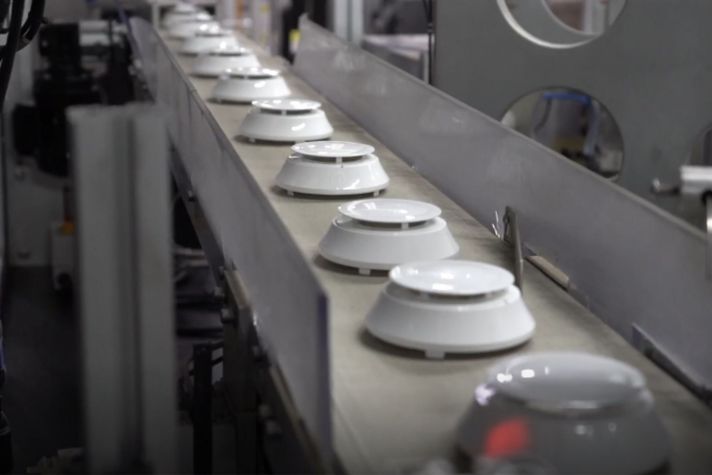
  • Smoke Detectors Plant

    We Make Cool Things in Juarez, Mexico: Devices That Power Buildings Worldwide

  • Two professionals in sweaters discussing data analysis while holding a laptop in front of server racks in a data center. Both wear identification lanyards and appear engaged in their conversation.

    8 Essential Questions to Ask Data Center Solution Providers

  • Discover the stunning design of a contemporary building with sleek lines, glass facades, and unique geometric patterns set against a vibrant blue sky.

    Building Smarter: The Power of Integrated Building Systems

A person with a tablet stands on a balcony above a brightly lit data center. Rows of active server racks with blinking lights stretch below, showcasing a high-tech infrastructure environment.

VESDA vs. Spot Detectors: Choosing the Right Solution for Your Data Center


Who We Are
toggle view
  • About Honeywell
  • Leadership
  • Patents
  • Partners
  • Trust Center
What We Do
toggle view
  • Buildings
  • Industrial
  • Process
Forge
toggle view
Accelerator OS
toggle view
Investors
toggle view
People
toggle view
  • Careers
  • Life at Honeywell
  • Your Career Journey
  • In The Community
  • Inclusion & Engagement
  • Integrity & Compliance
  • Job Opportunities
  • Meet Our People
Businesses
toggle view
  • Building Automation
  • Industrial Automation
  • Process Automation & Technology
News
toggle view
  • Articles
  • Events
  • Press Releases
Industries
toggle view
  • Buildings
  • Chemical & Materials
  • Data Centers
  • Healthcare
  • Heavy Industries
  • Hospitality
  • Life Sciences
  • LNG
  • Low-Carbon Energy
  • Manufacturing
  • Oil & Gas
  • Utilities
Outcomes
toggle view
  • Asset Management
  • Energy Innovation
  • Life Safety & Security
  • Operational Efficiency
  • OT Cybersecurity
  • Workforce Excellence
Legal
toggle view
  • Accessibility
  • Certifications
  • Patents
  • Suppliers
  • Warranties
Support
toggle view
Contact Us
toggle view
  • Business Inquiries
  • Employee Access
  • Retiree Access
Honeywell Technologies horizontal logo allowing users to navigate to the homepage of honeywell.com.
toggle view
  • Contact Us
Follow Us
  • LinkedIn
  • Facebook
  • YouTube
  • Instagram

Copyright © 2026 Honeywell International Inc

Terms & Conditions
Privacy Statement
Your Privacy Choices
Cookie Notice
Global Unsubscribe

We use cookies and similar tracking online technologies to improve website performance, record website activities, facilitate information sharing on social media and offer advertising tailored to your interest. For more information, see our Cookie Notice and Terms and Conditions. You can also customize your browser’s cookie settings. Please note that if you refuse cookies, it may affect site functionality and performance.