Honeywell Technologies Honeywell Technologies
  • Who We Are
    • About Honeywell Join Honeywell on the Journey to Autonomy
    • Leadership Our senior leadership team
    • Partners Our partners in delivering value and transformation.
    Newsroom
    Explore our latest news
    Honeywell Expands Fire Portfolio with Advanced Smoke Control and Connected Life Safety Innovations
    Honeywell and MIT Find Digital Technologies can Help Increase Energy Supply, Reduce Energy Production Cost by Tens of Billions Annually
    Honeywell Technologies Hosts 2026 Investor Day; Provides New Three-Year Financial Framework
  • What We Do
    • Buildings Creating the next era of building automation
    • Industrial Driving the autonomous plant forward
    • Process Creating new energy opportunities
    Insights Hub
    Explore our latest insights
    Earn The Employee Commute Back to the Office
    CLSS is a Game-changer for Fire System Testing
    Honeywell Predicts The Top Three Building Trends of 2024
  • Honeywell Forge
  • Accelerator OS
  • Investors
  • People
    • Careers Help us build a better future
    • Life at Honeywell Discover our employee values
    • Your Career Journey When you grow, we grow
    • In the Community How we support our communities
    • Inclusion & Engagement Global perspectives for a diverse workforce
    • Integrity & Compliance Creating a culture of trust and transparency
    • Job Opportunities Find a new career with Honeywell
    • Meet Our People Get to know our truly amazing talent

    Job Opportunities

    Help shape the future of Honeywell Technologies
    Find a Career
    Professional portrait of an individual seated at a desk with a laptop against a clean background with subtle color gradient in corner.
  • Newsroom
  • Solutions
    Industries
    • Buildings
    • Chemicals + Materials
    • Data Centers
    • Healthcare
    • Heavy Industries
    • Hospitality
    • Life Sciences
    • LNG
    • Manufacturing
    • Oil + Gas
    • Low Carbon Energy
    • Utilities
    Outcomes
    • Asset Management
    • Energy Innovation
    • Operational Efficiency
    • OT Cybersecurity
    • Life Safety & Security
    • Workforce Excellence
    Businesses
    • Building Automation
    • Industrial Automation
    • Process Automation & Technology
    View All Solutions →

    Honeywell Forge

    AI-Powered, enterprise-level outcomes.
    Explore Honeywell Forge
    Vertical abstract red background with gradient tones and glowing accents, suitable for corporate visuals, digital assets, and design layouts.
    • Americas

        • Brazil - Portuguese
        • Canada - English
        • Canada - French
        • Mexico - Spanish
        • United States - English
    • APAC

        • Australia - English
        • Japan - Japanese
        • Malaysia - English
        • Republic of Korea - Korean
        • Singapore - English
    • Europe

        • Czech Republic - Czech
        • Czech Republic - English
        • Denmark - English
        • France - French
        • Germany - German
        • Italy - Italian
        • Netherlands - Dutch
        • Netherlands - English
        • Poland - Polish
        • Romania - Romanian
        • Romania - English
        • Spain - English
        • Spain - Spanish
        • United Kingdom - English
    • META

        • Saudi Arabia - Arabic
        • Saudi Arabia - English
        • Turkey - English
        • Turkey - Turkish
        • United Arab Emirates - Arabic
        • United Arab Emirates - English
    • India

        • India - English
    • China

        • China - Chinese
  • Contact
  • Support

You are browsing the product catalog for

You are viewing the overview and resources for

Sign in

to view parts associated with your account

  • Home
  • Insights
  • Learn the Difference between Two Important Pieces of Technology

Learn the Difference between Two Important Pieces of Technology

Both types of detectors can detect a fire, but these products are designed to serve different needs.

Published on 05-01-2018 Published on 05-01-2018 3 min read

We’re often asked about best practices for when to use heat detectors vs smoke detectors. Both types of detectors can detect a fire, but these products are designed to serve different needs.

Heat Detectors vs Smoke Detectors

In a nutshell, here’s the difference between heat detectors and smoke detectors:

Heat detectors are intended to minimize property damage by reacting to the change in temperature caused by a fire.

Smoke detectors are intended to protect people and property by generating an alarm earlier in the development of a fire. People need time to react, and every second is critical during an actual fire event.

When it comes to protecting people, it is critical to warn building occupants before smoke accumulates. Some types of fires “smolder,” or burn very slowly without flames. Burning slowly causes incomplete combustion, which in turn generates more smoke, carbon monoxide, and other poisonous gases. Smoldering fires also generate very little heat, making them difficult to detect with heat detectors. When people are harmed during a fire, the culprit is almost always smoke and poisonous gases like CO: not the heat or flames.

If smoke detectors are the ideal solution for protecting lives, why do we still see heat detectors being installed instead of smoke detectors?

When property protection is the primary objective, heat detectors can be a reliable and virtually trouble-free solution. In some cases, heat detectors are chosen because of their low cost and greater immunity to contaminants and environmental extremes. In other cases, the heat detectors are used to trigger fire sprinklers or other types of fire suppression systems.

Today’s multi-criteria spot detectors and aspirating smoke detectors are designed to tolerate higher levels of airborne contaminants and broader temperature ranges. Although these solutions are generally more costly than heat detectors, they respond much earlier. In addition to giving building occupants more time to react, advanced smoke detectors often allow first responders to address the fire hazard before serious property damage occurs. Our application guides can help you determine if either multi-criteria spot detectors or aspirating smoke detectors are the right solution for your application.

When smoke detection is not practical, choosing a faster-acting heat detector can provide a quicker response time. 

Standard, fixed-temperature heat detectors respond as expected in a majority of fires, but they suffer from thermal lag when fires build quickly. “Thermal lag” occurs when rapid temperature increases cause the heat detector to alarm at a temperature higher than its set point. Adding rate-of-rise capability can speed up reaction times to fast-building fires, but they can also lead to false alarms if the installation environment naturally sees rapid changes to the ambient temperature. Rate-of-rise compensated fixed-temperature detectors can help to prevent both thermal lag and false alarms due to rapid temperature changes. These detectors respond like a standard, fixed-temperature heat detector with slowly developing fires. When fires build quickly, the rate-of-rise compensation prevents thermal lag, allowing these detectors to respond when their set point is reached.

For more information including detector spacing requirements, dealing with various ceiling types, or special applications, refer to the National Fire Alarm and Signaling Code (NFPA 72) and your locally applicable codes and standards.

Contact us
Related Content
  • Smoke Detectors Plant
    Buildings
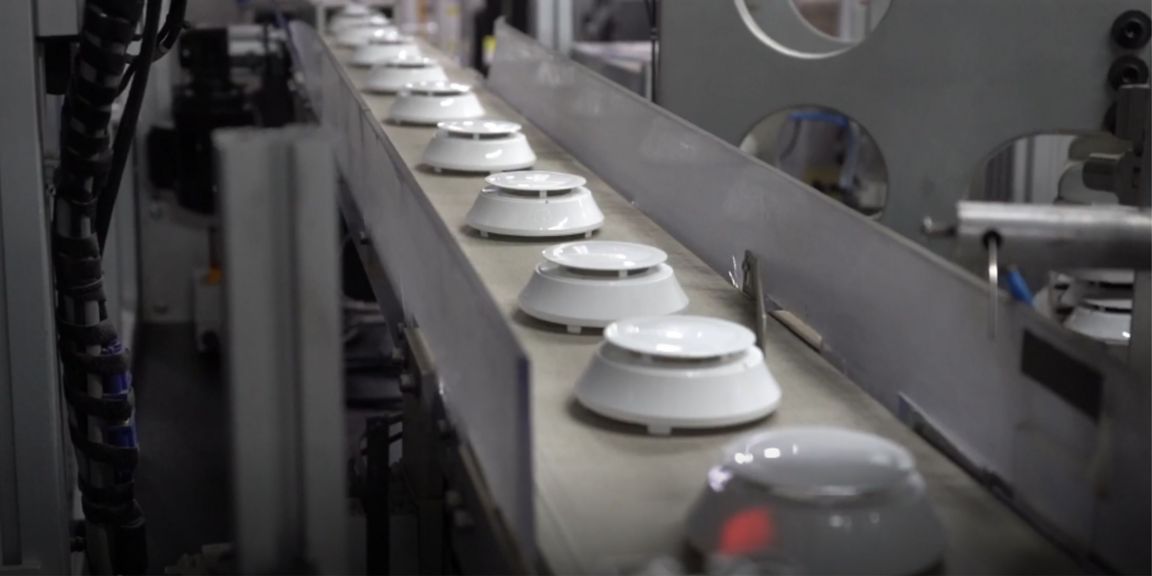
    We Make Cool Things in Juarez, Mexico: Devices That Power Buildings Worldwide

    Our teams build innovation from the circuit board up—designing, assembling and testing smart building technologies, including more than 3 million smoke detectors a year.

  • Discover the stunning design of a contemporary building with sleek lines, glass facades, and unique geometric patterns set against a vibrant blue sky.
    Buildings
    Building Smarter: The Power of Integrated Building Systems

    Find out how Honeywell is transforming enterprise-level building systems by integrating core functions like HVAC, lighting and security into intelligent, energy-efficient ecosystems to enhance performance, comfort and sustainability.

  • Grand Opening Ribbon Cutting - Honeywell
    Buildings
    Germany’s Transition Toward Industrial Autonomy: Recap of Our 2025 European Growth Symposium

    Discover how Honeywell’s 2025 Growth Symposium in Munich is shaping Europe’s future with AI, connected tech, and a new facility in Ratingen.

  • Show More
Vibrant Abstract Smoke Flow: Blue and Red Swirls on Black Background

Heat Detectors vs Smoke Detectors: What's the Difference?

Who We Are
toggle view
  • About Honeywell
  • Leadership
  • Patents
  • Partners
  • Trust Center
What We Do
toggle view
  • Buildings
  • Industrial
  • Process
Forge
toggle view
Accelerator OS
toggle view
Investors
toggle view
People
toggle view
  • Careers
  • Life at Honeywell
  • Your Career Journey
  • In The Community
  • Inclusion & Engagement
  • Integrity & Compliance
  • Job Opportunities
  • Meet Our People
Businesses
toggle view
  • Building Automation
  • Industrial Automation
  • Process Automation & Technology
News
toggle view
  • Articles
  • Events
  • Press Releases
Industries
toggle view
  • Buildings
  • Chemical & Materials
  • Data Centers
  • Healthcare
  • Heavy Industries
  • Hospitality
  • Life Sciences
  • LNG
  • Low-Carbon Energy
  • Manufacturing
  • Oil & Gas
  • Utilities
Outcomes
toggle view
  • Asset Management
  • Energy Innovation
  • Life Safety & Security
  • Operational Efficiency
  • OT Cybersecurity
  • Workforce Excellence
Legal
toggle view
  • Accessibility
  • Certifications
  • Patents
  • Suppliers
  • Warranties
Support
toggle view
Contact Us
toggle view
  • Business Inquiries
  • Employee Access
  • Retiree Access
Honeywell Technologies horizontal logo allowing users to navigate to the homepage of honeywell.com.
toggle view
  • Contact Us
Follow Us
  • LinkedIn
  • Facebook
  • YouTube
  • Instagram

Copyright © 2026 Honeywell International Inc

Terms & Conditions
Privacy Statement
Your Privacy Choices
Cookie Notice
Global Unsubscribe

We use cookies and similar tracking online technologies to improve website performance, record website activities, facilitate information sharing on social media and offer advertising tailored to your interest. For more information, see our Cookie Notice and Terms and Conditions. You can also customize your browser’s cookie settings. Please note that if you refuse cookies, it may affect site functionality and performance.