Honeywell Technologies Honeywell Technologies
  • Who We Are
    • About Honeywell Join Honeywell on the Journey to Autonomy
    • Leadership Our senior leadership team
    • Partners Our partners in delivering value and transformation.
    Newsroom
    Explore our latest news
    Honeywell Expands Fire Portfolio with Advanced Smoke Control and Connected Life Safety Innovations
    Honeywell and MIT Find Digital Technologies can Help Increase Energy Supply, Reduce Energy Production Cost by Tens of Billions Annually
    Honeywell Technologies Hosts 2026 Investor Day; Provides New Three-Year Financial Framework
  • What We Do
    • Buildings Creating the next era of building automation
    • Industrial Driving the autonomous plant forward
    • Process Creating new energy opportunities
    Insights Hub
    Explore our latest insights
    Earn The Employee Commute Back to the Office
    CLSS is a Game-changer for Fire System Testing
    Honeywell Predicts The Top Three Building Trends of 2024
  • Honeywell Forge
  • Accelerator OS
  • Investors
  • People
    • Careers Help us build a better future
    • Life at Honeywell Discover our employee values
    • Your Career Journey When you grow, we grow
    • In the Community How we support our communities
    • Inclusion & Engagement Global perspectives for a diverse workforce
    • Integrity & Compliance Creating a culture of trust and transparency
    • Job Opportunities Find a new career with Honeywell
    • Meet Our People Get to know our truly amazing talent

    Job Opportunities

    Help shape the future of Honeywell Technologies
    Find a Career
    Professional portrait of an individual seated at a desk with a laptop against a clean background with subtle color gradient in corner.
  • Newsroom
  • Solutions
    Industries
    • Buildings
    • Chemicals + Materials
    • Data Centers
    • Healthcare
    • Heavy Industries
    • Hospitality
    • Life Sciences
    • LNG
    • Manufacturing
    • Oil + Gas
    • Low Carbon Energy
    • Utilities
    Outcomes
    • Asset Management
    • Energy Innovation
    • Operational Efficiency
    • OT Cybersecurity
    • Life Safety & Security
    • Workforce Excellence
    Businesses
    • Building Automation
    • Industrial Automation
    • Process Automation & Technology
    View All Solutions →

    Honeywell Forge

    AI-Powered, enterprise-level outcomes.
    Explore Honeywell Forge
    Vertical abstract red background with gradient tones and glowing accents, suitable for corporate visuals, digital assets, and design layouts.
    • Americas

        • Brazil - Portuguese
        • Canada - English
        • Canada - French
        • Mexico - Spanish
        • United States - English
    • APAC

        • Australia - English
        • Japan - Japanese
        • Malaysia - English
        • Republic of Korea - Korean
        • Singapore - English
    • Europe

        • Czech Republic - Czech
        • Czech Republic - English
        • Denmark - English
        • France - French
        • Germany - German
        • Italy - Italian
        • Netherlands - Dutch
        • Netherlands - English
        • Poland - Polish
        • Romania - Romanian
        • Romania - English
        • Spain - English
        • Spain - Spanish
        • United Kingdom - English
    • META

        • Saudi Arabia - Arabic
        • Saudi Arabia - English
        • Turkey - English
        • Turkey - Turkish
        • United Arab Emirates - Arabic
        • United Arab Emirates - English
    • India

        • India - English
    • China

        • China - Chinese
  • Contact
  • Support

You are browsing the product catalog for

You are viewing the overview and resources for

Sign in

to view parts associated with your account

  • Home
  • Insights
  • Quiet, Reliable Technology helps in Controlled Spaces

Quiet, Reliable Technology helps in Controlled Spaces

Nearly every hospital has an adjustable HVAC system to manage air flow, but many hospitals have aging mechanical infrastructure.

Published on 04-01-2020 Published on 04-01-2020 3 min read

When a hospital treats a patient with an infectious disease, the first concern is the patient’s health. The second is containing the disease so that it doesn’t spread to other patients or health care workers. The most obvious weapons in this fight are rigorous sanitization practices and personal protection equipment like disposable gloves, masks and gowns that health care workers use when treating patients.

Viruses don’t limit themselves to surfaces; common illnesses, like influenza, measles and chickenpox, can be spread by airborne transmission. In these cases, the Centers for Disease Control and Prevention recommends that infectious patients be placed in an isolation room. The intent of an isolation room is to stop the spread. 

Meeting High Standards

The guidelines for management and construction of isolation rooms are specific, especially when it comes to controlling air flow into and out of the room. Phoenix Controls’ David Rausch, works with hospitals to make sure their HVAC systems are operating properly. “The CDC makes the standards clear and easy to follow,” says Rausch. “The hospital just has to look under the ceiling tiles and say, can we do this?”

An Airborne Infection Isolation (AII) space requires a minimum negative pressure of 0.01 in Inches in Water Column (WC) and 12 Air Changes per Hour (ACH). This negative pressure needs to be monitored constantly while the space is occupied. “Good directional air flow, that’s key.” says Rausch. “Pull the bad air out, away from the staff and other patients, so it can’t infect anyone inside.”

Nearly every hospital has an adjustable HVAC system to manage air flow, but Rausch says many hospitals have aging mechanical infrastructure that is already taxed and its struggling to consistently manage airflow. “The standard equipment works broadly, but it overshoots and undershoots until it finds the right air flow management.” Rausch says that becomes a problem in isolation rooms. “That back and forth to find the right setting compromises the isolation guidelines.”

Quietly Exceeding Standards

Seeking to maintain or exceed guidelines, many hospitals have adopted the Venturi valve by Phoenix Controls. “The valve stabilizes directional flow and maintains exhaust, tracking the supply to guarantee directional flow,” says Rausch. “It's a much more reliable technology that helps to maintain a space for these types of situation guaranteed, all the time.”

In one study, when a Phoenix Venturi valve was tested and compared to a typical VAV Box system, the Venturi was more responsive and effective in reducing airborne particulate in an ICU patient room.1 The stable, directional flow produced by the Phoenix Controls Venturi valve, purged the space more efficiently which ultimately can reduce a hospital’s infection risk for that space.

The Next 10 Years

Hospitals have significant clinical and patient data – and so does the physical building. In the future, it will be about pairing the building data and insights with clinical data to help improve patient outcomes and experience. “Healthcare facilities are advancing from a quality of care standpoint, but often the buildings have been forgotten.” says Rausch, but he sees big changes ahead.

“Sensing, monitoring and analytics are coming on board more and they’re being examined in clinical care routine. The building and the clinicians have been separate entities, they’ll be integrated more in the future, working together.”

Phoenix Controls is a wholly owned company of Honeywell International.

Sources:

1. The Center for Health Design, Analyzing ICU Patient Room Environmental Quality Through Unoccupied, Normal, and Emergency Procedure Modes: An EQI Evaluation, 2019

Contact Us
Related Content
  • A warehouse worker uses a handheld barcode scanner to manage inventory efficiently in a busy storage environment. Perfect for enhancing supply chain operations.
    Healthcare
    How Honeywell & SOTI Drive Faster, Smarter Mobile Operations

    Discover how Honeywell and SOTI integrate mobile tech and software to boost speed, data insights, and efficiency across logistics, retail, and healthcare.

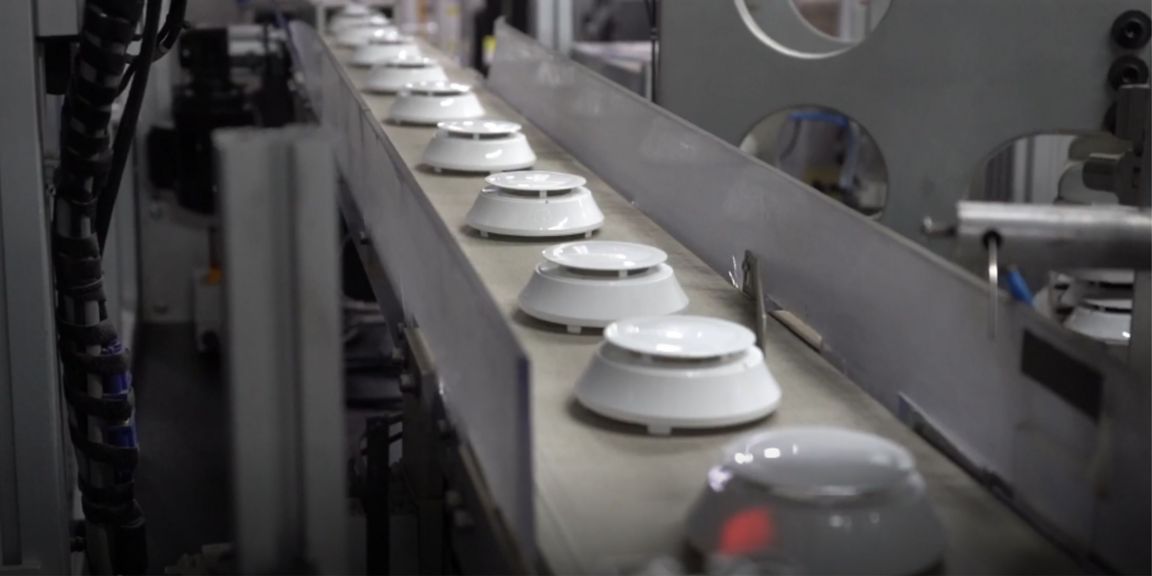
  • Smoke Detectors Plant
    Buildings
    We Make Cool Things in Juarez, Mexico: Devices That Power Buildings Worldwide

    Our teams build innovation from the circuit board up—designing, assembling and testing smart building technologies, including more than 3 million smoke detectors a year.

  • A medical professional in a lab coat works on a computer, analyzing data displayed on multiple monitors in a modern office setting. The screens show graphs and data tables related to health information.
    Healthcare
    How Automation Simplifies Regulatory Compliance in Hospitals

    Automation can empower hospitals to meet evolving regulations, helping them to streamline compliance, enhance safety and scale with confidence.

  • Show More
Air quality exemplified through HVAC system and a green plant

Quiet, Reliable Technology helps in Controlled Spaces

Who We Are
toggle view
  • About Honeywell
  • Leadership
  • Patents
  • Partners
  • Trust Center
What We Do
toggle view
  • Buildings
  • Industrial
  • Process
Forge
toggle view
Accelerator OS
toggle view
Investors
toggle view
People
toggle view
  • Careers
  • Life at Honeywell
  • Your Career Journey
  • In The Community
  • Inclusion & Engagement
  • Integrity & Compliance
  • Job Opportunities
  • Meet Our People
Businesses
toggle view
  • Building Automation
  • Industrial Automation
  • Process Automation & Technology
News
toggle view
  • Articles
  • Events
  • Press Releases
Industries
toggle view
  • Buildings
  • Chemical & Materials
  • Data Centers
  • Healthcare
  • Heavy Industries
  • Hospitality
  • Life Sciences
  • LNG
  • Low-Carbon Energy
  • Manufacturing
  • Oil & Gas
  • Utilities
Outcomes
toggle view
  • Asset Management
  • Energy Innovation
  • Life Safety & Security
  • Operational Efficiency
  • OT Cybersecurity
  • Workforce Excellence
Legal
toggle view
  • Accessibility
  • Certifications
  • Patents
  • Suppliers
  • Warranties
Support
toggle view
Contact Us
toggle view
  • Business Inquiries
  • Employee Access
  • Retiree Access
Honeywell Technologies horizontal logo allowing users to navigate to the homepage of honeywell.com.
toggle view
  • Contact Us
Follow Us
  • LinkedIn
  • Facebook
  • YouTube
  • Instagram

Copyright © 2026 Honeywell International Inc

Terms & Conditions
Privacy Statement
Your Privacy Choices
Cookie Notice
Global Unsubscribe

We use cookies and similar tracking online technologies to improve website performance, record website activities, facilitate information sharing on social media and offer advertising tailored to your interest. For more information, see our Cookie Notice and Terms and Conditions. You can also customize your browser’s cookie settings. Please note that if you refuse cookies, it may affect site functionality and performance.